Whole-Home Remodel: Where to Start (Even If You're Overwhelmed)

If you're standing in your house right now trying to figure out where a whole-home remodel even begins, that feeling is normal. Every room seems to need something. Every decision seems to depend on another decision you haven't made yet. It's a lot to hold in your head at once, and most people freeze somewhere in that first week of thinking about it.
The good news is that the overwhelm isn't really about the size of the project, even a complex full-house renovation. It's about trying to make every decision at the same time, in no particular order. There's a sequence (a general order) that gets you unstuck, and it starts well before paint colors, a new color palette, or contractor quotes.
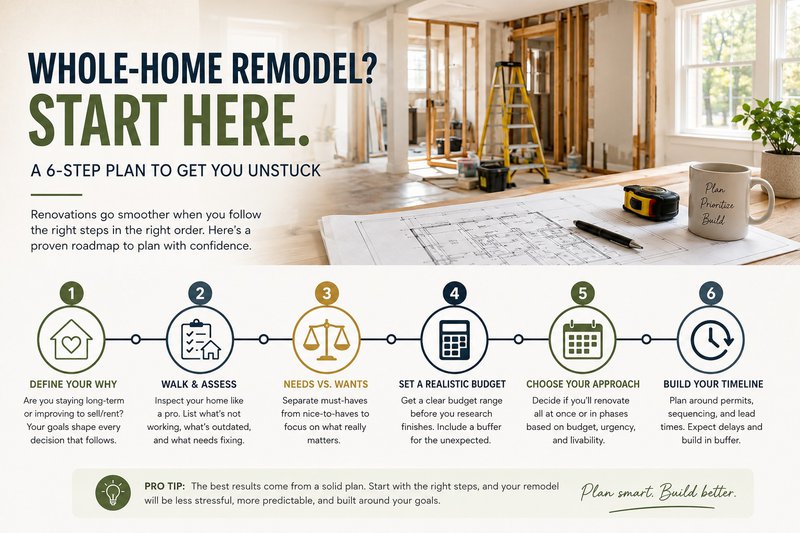
The short version:
- Get clear on why you're remodeling (long-term home vs. investment)
- Walk the house and list what's actually not working
- Separate needs from wants
- Get a realistic budget range before researching finishes
- Decide: phased project or all at once
- Turn the scope and budget into a timeline
Why This Decision Feels So Overwhelming
A whole-home remodel touches nearly every part of daily life: budget, timeline, where you'll live during construction, which rooms matter most, and what your priorities actually are. When all of that arrives at once, it’s easy to mistake "I don't know where to start" for "I'm not ready to do this." Usually it just means the decisions haven’t been put in order yet.
This is the most common version of the big question: whole home remodel where to start, when everything feels connected to everything else. The answer is to work through a short list of decisions in a specific order, a step-by-step guide, rather than trying to solve the entire home (or entire home remodeling job) in one sitting.
Step 1: Get Clear on Why You're Remodeling
Before anything else, settle the answer to one question: is this home where you plan to stay for years, or is it a property you're improving to sell or rent? The answer changes almost every decision that follows, including your goals.
If you're staying long-term, the priority is how the home functions for your life: layout, flow, the floor plan, comfort, and the rooms you actually use every day (or any new rooms you’re hoping to add). If this is an investment property, the priority shifts toward what actually increases value relative to cost, and what supports profit. Renovations that make sense for a forever home (a custom built-in office, for instance) don't always make sense for a flip, and the reverse is also true. Getting this settled first is the first major step and prevents a lot of second-guessing later.
Step 2: Walk the House Like an Inspector, Not a Homeowner
Most people start a remodel by imagining the finished result. It's more useful to start by walking through the house room by room and writing down what's actually not working: outdated systems, awkward layouts, rooms that go unused, drafty doors, missing or failing insulation, anything that's a genuine problem rather than a preference. (If it’s a historic home, note what must be preserved or handled differently.)
This list becomes the raw material for scope. Someone who says "I want to remodel my house where do I start" is often standing in a house full of small frustrations that haven't been written down anywhere. Getting them onto paper is usually the first real step, well before any design ideas, light fixtures, or finish decisions.
Step 3: Separate Needs From Wants
Once the walkthrough list exists, split it into two categories: things that need to be fixed regardless of budget (a failing roof, outdated wiring, a layout that doesn't work for the household) and things that would be nice but aren't urgent (a larger kitchen island, a different tile pattern, upgraded doors, or swapping light fixtures).
This single sorting exercise does more to clarify a whole home remodel where to start than almost anything else, because it turns a vague sense of "everything needs work" into two concrete, ranked lists, and it builds confidence that you’re making decisions with the right approach.
Step 4: Get a Realistic Sense of Budget Before You Fall in Love with Ideas
It's tempting to research finishes and layouts before knowing what's actually affordable. Flipping that order almost always leads to disappointment, since it's much harder to scale back a plan you're already attached to than to build one within real constraints from the start.
At this stage, a rough budget range is enough. You don't need exact numbers yet, just an honest sense of what you're able to spend, including a contingency for the unknowns that come up once work begins. This is also the moment to start sanity-checking price ranges with a builder or a professional remodeler, because early feedback can prevent expensive rework. (If cost is the main thing holding you back from starting, [How to Remodel a House on a Budget] walks through how to plan a renovation around a fixed number rather than an open-ended one.)
Step 5: Decide Whether This Is a Phased Project or All at Once
Not every whole-home remodel happens in one continuous project. Many homeowners and investors phase the work: structural and systems work first, cosmetic work later, room by room over a year or two rather than all at once. This decision depends on budget, how livable the home needs to stay during construction, and how urgent the "needs" list from Step 3 actually is. In a green home remodeling plan, this is often where upgrades like insulation and mechanical improvements get prioritized early for comfort and performance.
There's no single right answer here. What matters is deciding deliberately, rather than defaulting into a phased approach out of indecision, or into an all-at-once approach because it feels faster, without checking whether the budget and timeline actually support it. (This is a big decision—and for many people, it’s the hardest part.)
Step 6: Turn the List Into a Timeline
Once scope and budget have a rough shape, the project needs a timeline, specifically one that accounts for permitting, sequencing, and the delays that show up in nearly every renovation. This is where permits (and other approvals) often set the pace, and where the earlier decisions get tested against reality: a phase you assumed would take a month might realistically take two once permitting and contractor availability are factored in.
This is also where the remodeling process becomes very real: demolition has to happen at the right time, long-lead items must be ordered, and there are a lot of moving parts across trades. For reference, many pros align timelines and standards with industry best practices (including guidance you’ll see referenced by organizations like NAHB).
How to Plan a Home Renovation: The Complete Timeline Guide walks through exactly how to build that timeline once you've reached this point, including a sample sequence and how much buffer to build in for the delays that catch most people off guard.
Where This Actually Begins
If there's one honest answer to whole home remodel where to start, it's this: not with a Pinterest board, and not with a contractor call. It's with an honest walkthrough of the house, a clear-eyed budget range, and a decision about whether this is a long-term home or an investment. Everything else, including the timeline, the design choices, and the contractor conversations, gets easier once those three things are settled.
If you’re looking for general whole home remodeling steps you can follow in order, or you’re planning a specific market like a DC home remodeling project, the same guideposts apply: set goals, define priorities, confirm budget and price reality, decide on a phase strategy, then start scheduling around permits and sequencing. It’s a great project, but it gets easier when you start in the right place.

Once you've worked through the steps above, the next thing that helps is a way to actually track it all in one place instead of across notes and browser tabs. RenovationPLN lets you scope, budget, and sequence a whole-home remodel with ARV and ROI visibility built in from the start, so you're not managing it across spreadsheets and guesswork.
Atoriz Scope
Scope turns renovation intent into a priced scope of work you can defend.