Remodeling Tips Every Homeowner Should Know Before Starting

Most home remodel tips fall into two categories: things that sound helpful but don't actually change an outcome, and things that would have saved someone real time or money if they'd known them before starting. This list is built from the second category, the important things, decisions, and habits that consistently separate renovations that run smoothly from ones that run over budget or past schedule.
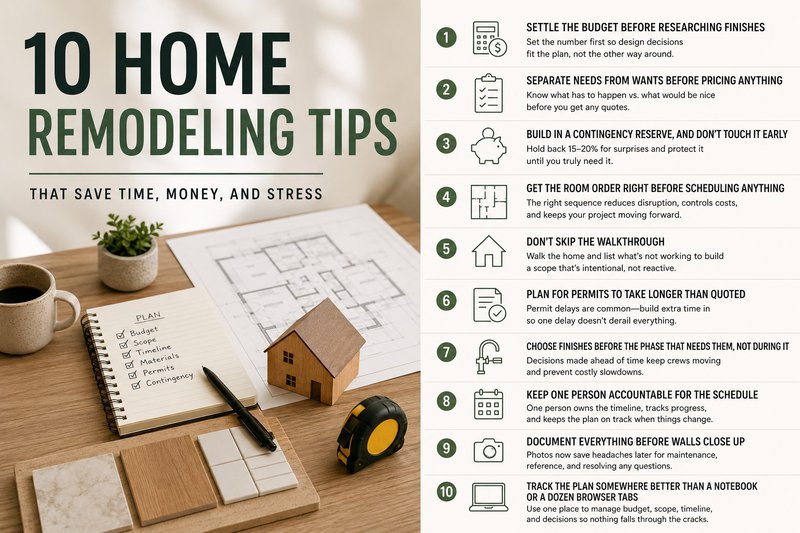
The short version:
- Settle the budget before researching finishes
- Separate needs from wants before pricing anything
- Build in a contingency reserve, and don't touch it early
- Get the room order right before scheduling anything
- Don't skip the walkthrough
- Plan for permits to take longer than quoted
- Choose finishes before the phase that needs them, not during it
- Keep one person accountable for the schedule
- Document everything before walls close up
- Track the plan somewhere better than a notebook or a dozen browser tabs
Here's why each one matters.
1. Settle the Budget Before Researching Finishes
Once a specific tile, new color, light fixtures, or layout has been researched and mentally chosen, cutting back to fit a real budget feels like a loss instead of a plan. Setting the number first, and letting design decisions flow from it, avoids that entirely. (How to Remodel a House on a Budget goes deeper on how to structure this.)
2. Separate Needs From Wants Before Pricing Anything
A failing roof and a nicer kitchen island are not the same category of decision, even though both cost money. Sorting the full list into "has to happen" and "would be nice" before getting quotes makes every budget conversation afterward much clearer for homeowners and their professional remodeler.
3. Build in a Contingency Reserve, and Don't Touch It Early
Most experienced planners hold back 15-20% of the total budget specifically for the unknowns that show up once demolition starts. The mistake isn't forgetting to plan for surprises, it's treating the contingency reserve as extra spending money before any surprises have actually happened. This is one of the most useful home remodeling tips for protecting a home remodeling project from unexpected costs.
4. Get the Room Order Right Before Scheduling Anything
Which room comes first isn't just a preference question, it depends on daily impact, traffic patterns, whether systems work is required, and how disruptive each room is to live around. Getting this sequence wrong is one of the more common reasons a renovation doesn't unfold the way it was planned. (Where to Start When Remodeling Your Home walks through the full framework.)
5. Don't Skip the Walkthrough
Before any design decisions, walk the house and write down what's actually not working: outdated systems, awkward layouts, rooms that go unused, and whether a new room or better access would improve the way the house functions. This becomes the raw material for scope, and skipping it usually means scope gets defined reactively instead of deliberately. (Whole-Home Remodel: Where to Start covers this in more detail if the project hasn't reached the planning stage yet.)
6. Plan for Permits to Take Longer Than Quoted
Permit timelines are one of the least controllable variables in any renovation, and local offices are frequently backed up beyond their stated turnaround. Building extra time into the schedule here, rather than assuming the best case, prevents a single delay from cascading through the rest of the project.
7. Choose Finishes Before the Phase That Needs Them, Not During It
Decision delays, fixtures and finishes not chosen in time, are one of the most common causes of a stalled project. Every phase that depends on a decision needs that decision made in advance, not while contractors are waiting on-site for an answer. The same applies to doors, insulation, heating, and other materials that affect home efficiency.
8. Keep One Person Accountable for the Schedule
Someone needs to own the timeline, track what's happening against what was planned, and make the call when a delay in one phase needs to ripple through the rest of the plan. An unmanaged schedule drifts, even when everyone involved is doing their individual job well. Whether that person is a homeowner, home designer, or professional remodeler, the responsibility needs to be clear.
9. Document Everything Before Walls Close Up
Photos of wiring, plumbing, and structural work before drywall goes up matter more than they seem to at the time, both for future maintenance and for resolving any disputes about what was actually done. This takes minutes and is easy to forget in the moment, especially during a daunting home remodeling job.
10. Track the Plan Somewhere Better Than a Notebook or a Dozen Browser Tabs
A renovation touches budget, scope, timeline, furniture size, and a long list of decisions, all of which shift as the project moves. Keeping that spread across a notebook, a spreadsheet, and a few saved links makes it easy to lose track of what's been decided and what hasn't. A single place to manage it tends to be the best way to keep a remodeled space, from a bedroom to a whole house, aligned with the original plan.
Putting These Remodeling Tips Into Practice
Individually, none of these home remodeling tips and ideas are complicated. What makes them effective is applying them in order, before the project starts, rather than discovering them mid-renovation when they're harder and more expensive to act on. They also give homeowners a practical starting point for green home remodeling, accessibility improvements, and timeless new homes. How to Plan a Home Renovation: The Complete Timeline Guide walks through how to bring scope, budget, and sequencing together into an actual schedule, if that's the next step.
Most of these remodeling tips come down to the same underlying problem: too many moving parts tracked in too many places. RenovationPLN brings scope, budget, timeline, and ROI visibility into one place, so the plan stays a plan instead of turning into a scramble once work begins.
Atoriz Scope
Scope turns renovation intent into a priced scope of work you can defend.